


how i got into Google my full story - Part - 2

Summary
I successfully navigated multiple challenging interview rounds at Google for an L3 position, overcoming anxiety and multiple reschedules, and eventually securing a team after a prolonged process.
Full Experience
Part 2 – The Rounds, The Standards, The Pressure
After getting that long-awaited email from Google HR, I had my initial screening — and I’d say I played all the right cards, because I cleared it and moved to the next step.
Soon, I was invited to an orientation call, where they broke down the entire interview process:
- 1 Telephonic Round: Focused on DSA/Coding (Eliminatory)
- Onsite Rounds (4 total, if you pass):
- 2 DSA rounds
- 1 Domain/DSA round (based on your experience)
- 1 Googliness round (behavioral)
Then came the telephonic round — the first big test. One thing to know about Google interviews: they often keep questions vague on purpose. Not to confuse you, but to observe how well you communicate, how you break down problems, and how deeply you think.
📌 Golden Rule for Google Interviews:
- Read the problem multiple times.
- Ask clarifying questions.
- Don’t rush into coding.
- They want clean, well-thought-out solutions — not quick fixes.
My telephonic round had two tree-based questions:
- One was centered on Inorder Traversal.
- The other seemed like a follow-up, but turned out to be completely independent — testing if I could recognize the difference and push back if needed.
I proposed alternate and optimized solutions to both — and that helped me stand out.
A week later, I got a call from HR: I passed! They asked for my availability for onsite interviews — five potential days. I agreed. My interviews were scheduled on four consecutive days, which was incredibly stressful.
In the week leading up, I was grinding hard on everything I ever struggled with:
KMP, Convex Hull, Segment Trees, and more. I was mentally exhausted, constantly questioning if I’d even make it.
Onsite Round 1
A two-pointer problem with precomputation, related to subarray sums.
Onsite Round 2
A recursive tree problem involving contiguous and isolated identical values.
Onsite Round 3
The interviewer didn’t show up, so it got postponed a week.
When it finally happened, it was a stack-based question involving bracket matching and equation simplification.
Googliness Round
Focused on behavioral aspects — leadership, pressure handling, communication, and ethics.
All these rounds, back to back, were mentally draining. I had panic attacks. At one point, I was literally crying and breathless during the interview, but somehow — I held it together.
I cleared 3 out of 4 rounds. The one I missed? The one where anxiety truly got the best of me.
Still, HR told me that passing 2 was enough, and I’d done really well — so they pushed me forward. I went through team matching and everything was going well... until it wasn’t.
Hiring Committee backed out , probably concerned about the one failed round, scheduled 2 more DSA interviews to be safe 🙃.
Then began a 2-month delay full of reschedules and uncertainty.
Onsite Round 4
An array-based problem involving greedy strategy, prefix sums, and hashmap balancing.
It felt like solving a complex necklace arrangement problem — but the question was poorly worded, and the test cases were brutal. I was on the edge the whole time.
Onsite Round 5
Thankfully, this was a Leetcode contest problem I’d solved 2 months ago and was daily problem a week ago 😉. The follow-up was the same, but seeing me solve quickly, the interviewer got suspicious and gave me a third follow-up.
Luckily, I had my heap, two-pointer, and binary search strategies ready — and nailed it.
After those two final rounds, I felt hopeful but also scared.
What if they think I cheated?
What if they drop me now?
I had worked too hard and come too far.
But the truth is — the real game is in how you communicate.
How you shape the problem, how you ask the right questions, how you structure your thoughts.
There were moments I was running out of time, but because my approach was solid and I picked the right data structures, I was given a pass.
A week later, HR called:
“It’s all positive! …But your matched team has moved on.”
Back to team-matching — again.
Two more weeks. Two more screenings.
Finally… I found my team.
In the next part, I’ll share how the salary negotiation unfolded, along with the perks, benefits, and everything else that came with the offer — stay tuned!
Answer to comments
1. YOE - 1.5 yrs, I have consistent leetcode streak, guardian and more than 2k problems solved on leetcode, i was in service base.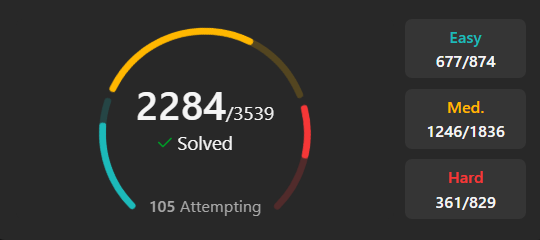
2. i got hired for L3
3. Sorry I cant share the exact problem from my interviews but it was 2 pointer problem with follow up as binary search and 2 pointer.
4. yes, my hr told me that i had 3 positive responses,I already knew i was fail in 1 interview so wasnt hard for me to understand which one they meant and the reasoning.
Interview Questions (2)
Bracket Matching and Equation Simplification
A stack-based question involving bracket matching and equation simplification.
Googliness / Behavioral Interview
Focused on behavioral aspects — leadership, pressure handling, communication, and ethics.
Preparation Tips
In the week leading up, I was grinding hard on everything I ever struggled with:
KMP, Convex Hull, Segment Trees, and more. I was mentally exhausted, constantly questioning if I’d even make it.
I have consistent leetcode streak, guardian and more than 2k problems solved on leetcode, i was in service base.